Artificial Intelligence is becoming a powerful part of our daily lives. One of the most talked-about tools
today is ChatGPT. From answering questions to helping write emails, it seems to know just about everything.
But how does it actually work?In this blog, we’ll explore the technology behind ChatGPT. We’ll break it down
in simple terms, so anyone can understand how this smart tool thinks, learns, and talks like a human.
Along the way, we’ll also look at other technologies that work together with ChatGPT and what the future
holds for AI tools like it.
What Is ChatGPT?
ChatGPT is a type of AI chatbot developed by OpenAI. It’s designed to understand what you type and
respond in a way that sounds natural and helpful. Whether you’re asking for writing help, coding advice,
or even fun facts, ChatGPT can respond quickly and intelligently. People use it for many purposes like
students use it for studying, professionals use it for brainstorming, and businesses use it to support
customers. Clearly, it’s more than just a chatbot—it’s a smart digital assistant.
Understanding the Core Technology Behind ChatGPT
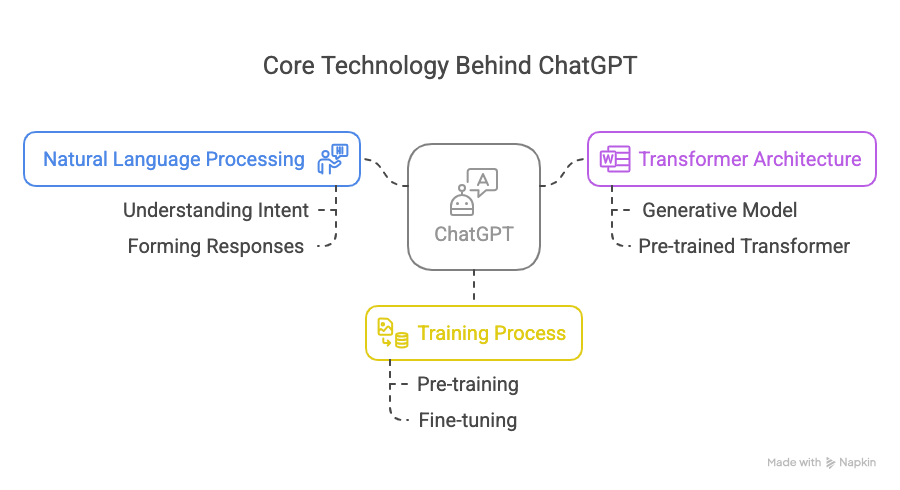
To understand how ChatGPT works, we need to look at the key parts of the technology behind ChatGPT.
1. Natural Language Processing (NLP)
NLP helps computers understand and use human language. When you type a question, ChatGPT
using NLP to figure out what you’re saying. It then forms a response that matches your intent.
This process happens in just a few seconds!
2. Transformer Architecture
The “GPT” in ChatGPT stands for Generative Pre-trained Transformer. The transformer is a special
model design that allows the AI to read large amounts of text and understand the relationships
between words. This makes ChatGPT’s answers feel smart and connected.
3. The Training Process
ChatGPT has been trained on a massive amount of data, like books, websites, and articles. First,
it’s “pre-trained” to understand general language patterns. Then, it’s “fine-tuned” using human
feedback to improve the quality of its answers.
Supporting Technologies Behind ChatGPT
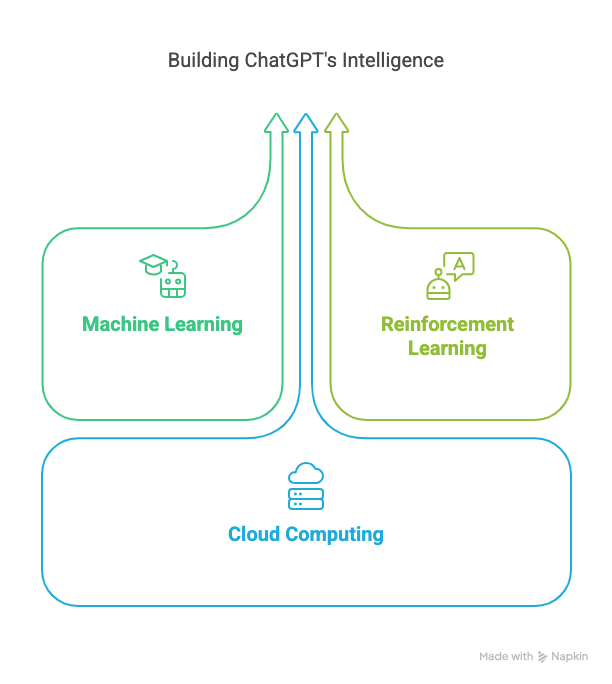
Several advanced systems work together to bring ChatGPT to life. Here are a few worth mentioning:
1. Machine Learning and Deep Learning
These allow ChatGPT to learn from the data it was trained on. Deep learning uses layers of artificial
“neurons” that mimic the way our brain processes information.
2. Reinforcement Learning from Human Feedback (RLHF)
LHF helps improve the model’s answers over time. Human trainers give feedback on ChatGPT’s
responses, teaching it to choose better answers in the future.
3. Cloud Computing
ChatGPT runs on powerful cloud servers. This makes it fast and easy to use from any device,
whether you’re on your phone, tablet, or computer.
The Technology Behind ChatGPT Compared to Other Models
ChatGPT isn’t the only AI model out there, but it’s one of the most popular. Let’s briefly compare it with a
few others:
- Google Bard focuses more on real-time internet access.
- Claude (Anthropic) is built with a focus on safety and alignment.
- Meta’s LLaMA is designed for research and lightweight use.
What makes ChatGPT stand out is its user-friendly design, wide range of plugins, and support
for various tasks all powered by the strong technology behind ChatGPT.
Real-World Applications of ChatGPT
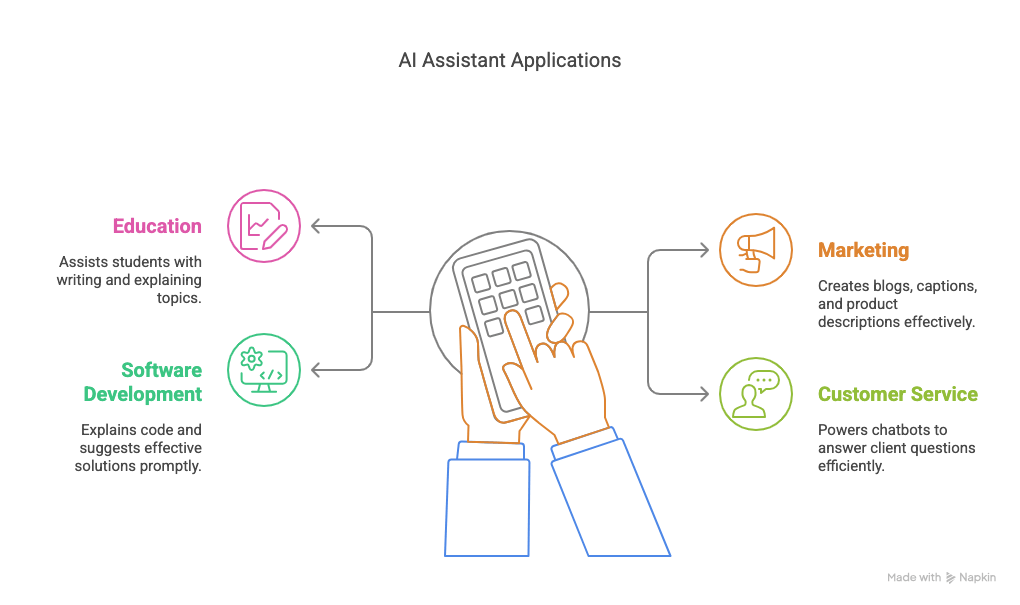
AI tools like ChatGPT are being used in many industries:
- Education: Helping students write essays and explain tough topics.
- Marketing: Writing blogs, captions, and product descriptions.
- Software Development: Explaining code and suggesting solutions.
- Customer Service: Powering chatbots that respond to client questions.
With so many uses, it’s clear that this technology is not just for tech experts it’s for everyone.
Ethical Issues and Limitations
While AI has many benefits, it’s not perfect. It’s important to understand the limitations of the
technology behind ChatGPT:
- It can sometimes provide outdated or incorrect information.
- It may reflect biases found in the data it was trained on.
- It doesn’t truly “understand” the world—it just predicts likely responses.
That’s why responsible use and human oversight are always important.
The Future of AI Language Models
AI is moving fast, and the future looks exciting. We may soon see:
- Multimodal models that understand text, images, and audio together.
- Personalized AI that adapts to your tone and preferences.
- Smarter tools that can work in real-time and learn from new data.
As technology grows, tools like ChatGPT will become even more helpful, creative, and intelligent.
Conclusion
The technology behind ChatGPT is complex but fascinating. By combining deep learning, NLP,
cloud computing, and human feedback, it creates conversations that feel natural and helpful.
Whether you’re a student, a professional, or just curious, understanding how ChatGPT works
helps you use it better—and more responsibly.
As AI continues to evolve, it’s clear that ChatGPT is just the beginning. There’s so much more
to come, and we’re only scratching the surface of what’s possible.
Curious to learn more about AI?
Explore more insights on how artificial intelligence is transforming everyday life.